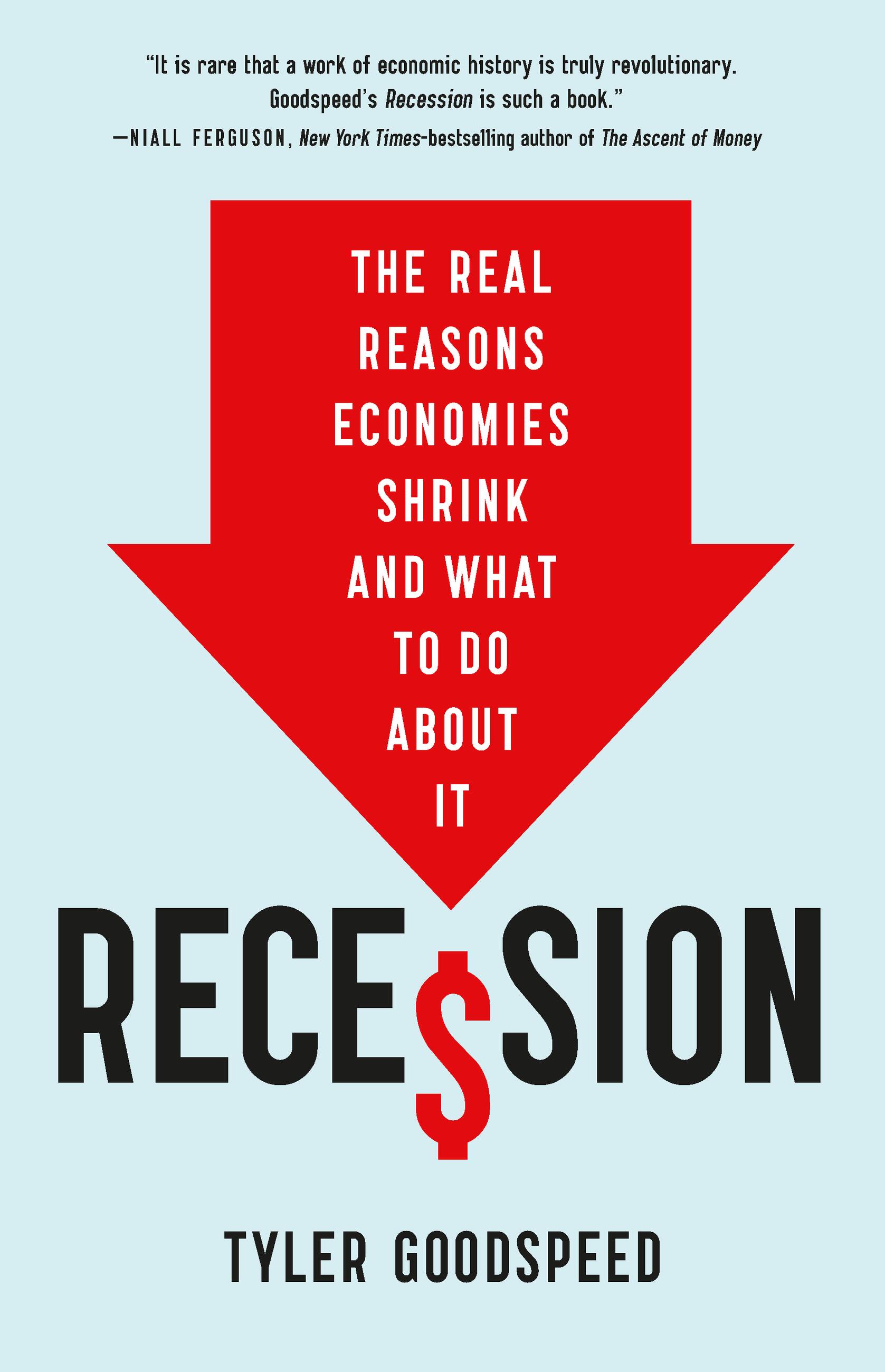
Recession
The Real Reasons Economies Shrink and What to Do About It

Contributors
Formats and Prices
- On Sale
- Mar 31, 2026
- Page Count
- 368 pages
- Publisher
- Basic Venture
- ISBN-13
- 9781541704961
Price
$18.99Price
$24.99 CADFormat
Format:
- ebook $18.99 $24.99 CAD
- Hardcover $30.00 $40.00 CAD
- Audiobook Download (Unabridged) $27.99
Buy from Other Retailers:
From a top economist, the real explanation for why recessions start, how long they last, and how to avoid them in the first place
“It is rare that a work of economic history is truly revolutionary. Goodspeed’s Recession is such a book.” ―Niall Ferguson, author of The Ascent of Money
What causes a recession? Do recessions end on their own, or do they require external intervention? Does a recession in one country mean the rest of the world will follow? Are we in a recession now?
Economic expert Tyler Goodspeed answers these questions and many more in Recession, a groundbreaking new analysis of economic contractions over the last four centuries. Combining the historian’s extensive primary source material and the economist’s arsenal of statistical analysis, this book rewrites what we know about recessions. Contrary to popular perception, recessions are not the inevitable bust that follows an unsustainable boom, and they do not operate like wildfires that clear out economic deadwood. Recessions are caused by adverse shocks like war and energy price spikes; and far from unleashing gales of creative destruction, post-recession economic growth typically resumes the same trend as before—all pain, no gain. While recessions have become less frequent over time, decisions made by businesses and governments can prolong recessions, and Goodspeed offers guidance to avoid making recessions worse. Issuing an important corrective to economic thinking, Recession is essential reading for high-level policymakers and armchair economists alike.
-
“The book is a neat distillation of economic thought surrounding recessions which bounces back and forth between detailed historical accounts of oh-so-specific recessions and empirical analysis. . . . Admirably clear.”Financial Times
-
“A brilliant analysis of economic expansions and recessions over several centuries and countries—essential reading to understand today’s challenges.”Mervyn King, former governor, Bank of England
-
“It is rare that a work of economic history is truly revolutionary. Goodspeed’s Recession is such a book. For generations, economists and policymakers have thought of recessions as cyclical ‘busts’ that invariably follow unsustainable ‘booms.’ Goodspeed echoes former Fed chair Ben Bernanke: Economic expansions don’t die of natural causes. They are murdered. But, like the murder on the Orient Express, there is usually more than one killer. This extraordinary tour de force confirms Goodspeed as one of the most brilliant economic minds of his generation. No economic downturn—including the Great Depression itself—will ever look quite the same again.”Niall Ferguson, New York Times–bestselling author of The Ascent of Money
-
“A deeply researched, engaging, and insightful look at the history of recessions in the US and UK. Suitable for researchers, students, and business economics enthusiasts alike.”Kenneth Rogoff, author of Our Dollar, Your Problem
-
“Recession is a captivating sequence of stories about the disparate shocks—involving imposters, grasshoppers, and wars—that explain recessions. And it is also an important counter to two unhistorical stories, one about the cyclical regularity of recessions and the other about their origin in the moral failures of antecedent expansions.”Emma Rothschild, author of Economic Sentiments
-
“Recession is a rigorous review, a very rewarding read, and a relevant recap of what we think we know (too much) and don’t know (a lot) about economic downturns by solely fixating on post-WWII data on the US. By extending the domain of analysis back hundreds of years and by expanding the span to include a parallel study of UK slumps, the author does the economics profession and the reader a valuable service. A must-read for practitioners, policymakers, and pundits.”Richard Clarida, former vice chair, Board of Governors of the Federal Reserve System
-
“With an artful blend of economic and historical analysis and extensive original data acquisition and translation, Goodspeed’s Recession is a must-read for all those interested in understanding recessions. Using data dating back to the 1700s in the US and UK, Goodspeed dispels simplistic narratives on the cause of recessions and shows that ‘each recession is unhappy in its own way.’ Recession will serve as a benchmark for much future research.”Michael J. Boskin, professor of economics, Stanford University, and former chairman, President’s Council of Economic Advisers
-
“What a wonderful, and wonderfully readable, book. It combines solid econometric analysis of a deep and wide range of historical data with beautiful writing and skillfully chosen anecdotes that are as entertaining as they are illuminating. The conclusions are very different to those of Charles Kindleberger, but in terms of its sheer intellectual power this is a worthy successor to as well as a powerful refutation of Manias, Panics, and Crashes.”Harold James, professor of history and international affairs, Princeton University
-
“In this brilliant book, Goodspeed effectively demolishes the common belief that recessions must inevitably follow economic expansions. Based on a beautiful historical, data-rich narrative of two centuries of business fluctuations in the UK and US, he provides very convincing evidence for Milton Friedman’s plucking model—that modern economies grow at their trend rates dependent on the deep economic fundamentals of the growth in physical and human capital and technical progress. This trajectory is occasionally disturbed by shocks of various types (mainly driven by bad policy). Yet, market forces quickly restore a return to trend.”Michael D. Bordo, distinguished professor emeritus, Rutgers University
-
“Tyler Goodspeed has a rare talent for weaving riveting stories of colorful characters and events with incisive economic analysis. The result is a monumental economic history of recessions in the U.S. and U.K. with appeal to both specialists and general audiences. Goodspeed’s book demolishes long-standing beliefs about the nature of recessions and puts names and faces to the macroeconomic ‘shocks’ that cause recessions. This book is destined to become required reading for anyone studying business cycles or contemplating macroeconomic policy.”Valerie Ramey, fellow, Hoover Institution, and chair of Recession Dating Committee, National Bureau of Economic Research