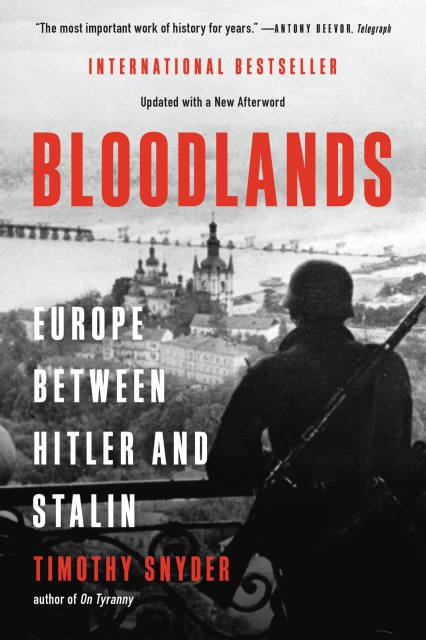
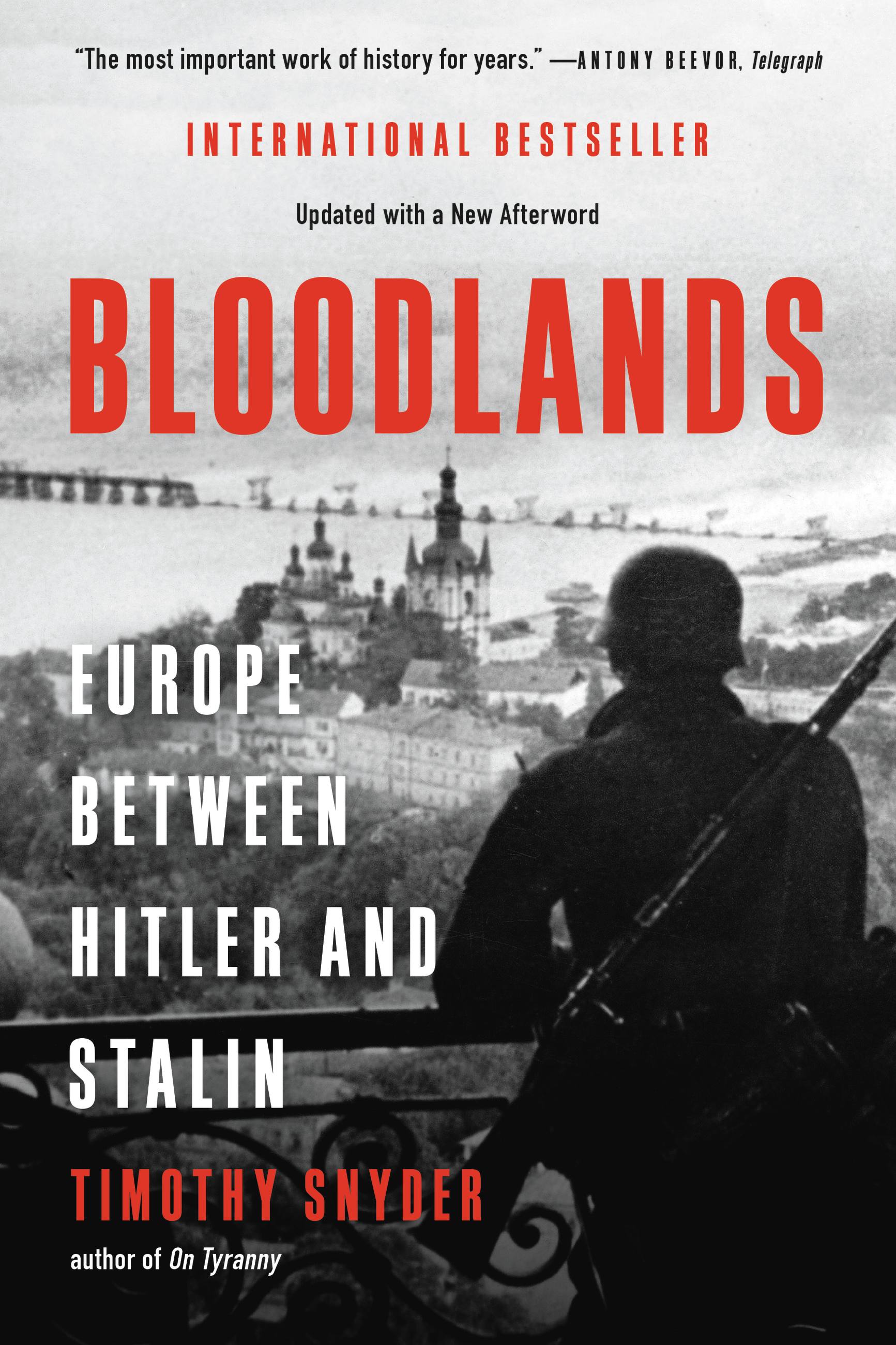
Bloodlands
Europe Between Hitler and Stalin
Contributors
Formats and Prices
- On Sale
- Oct 2, 2012
- Page Count
- 544 pages
- Publisher
- Basic Books
- ISBN-13
- 9780465032976
Price
$15.99Price
$20.99 CADFormat
Format:
- ebook $15.99 $20.99 CAD
- Audiobook Download (Unabridged)
- Trade Paperback $22.99 $29.99 CAD
Buy from Other Retailers:
The definitive history of Hitler and Stalin’s politics of mass killing, explaining why Ukraine has been at the center of Western history for the last century, from the author of the international bestseller, On Tyranny.
Americans call the Second World War “the Good War.” But before it even began, America’s ally Stalin had killed millions of his own citizens, and kept killing them during and after the war. Before Hitler was defeated, he had murdered six million Jews and nearly as many other Europeans. At war’s end, German and Soviet killing sites fell behind the Iron Curtain, leaving the history of mass killing in darkness.
Assiduously researched, deeply humane, and utterly definitive, Bloodlands is a new kind of European history, presenting the mass murders committed by the Nazi and Stalinist regimes as two aspects of a single story. Bloodlands is a required reading for anyone seeking to understand the central tragedy of modern history and its meaning today.
Genre:
-
Named a Best Book of the Year by Atlantic * Economist * Financial Times * New Republic * History Today * Independent * New Statesman * Seattle Times * Telegraph * Jewish Forward * Reason Magazine
-
“A gigantic achievement in modern history.”Rachel Maddow
-
“Snyder shows what really took place between 1930 and 1945 in the Baltic states, Belarus, Poland, and Ukraine. From the Stalinist famines to the death marches of 1945 and the mass ethnic cleansing, these borderlands were the focus of both Stalin’s and Hitler’s ideological obsessions.”Antony Beevor, Telegraph (UK), Book of the Year
-
“A brave and original history of mass killing in the twentieth century.”Anne Applebaum, New York Review of Books
-
“Gripping and comprehensive, Mr. Snyder’s book is revisionist history of the best kind: in spare, closely argued prose, with meticulous use of statistics, he makes the reader rethink some of the best-known episodes in Europe’s modern history.”Economist
-
“Each fashioned a terrifying orgy of deliberate mass killing. . . . Snyder punctuates his comprehensive and eloquent account with brief glimpses of individual victims, perpetrators, and witnesses.”New York Times Book Review
-
“Between 1933 and 1945, 14 million people were murdered in Eastern Europe. Bloodlands: Europe Between Hitler and Stalin catalogues how, where, and why these millions died. The cumulative effect makes you reconsider every aspect of modern Europe and World War II. Along the way, Snyder achieves something more vital: he wrests back some human dignity for those who died, without treating them solely as victims.”New Republic, Editors’ Picks, Best Books of the Year
-
“Snyder’s research is careful and thorough, his narrative powerful. . . . By including Soviet with German mass atrocities in his purview, Timothy Snyder begins the necessary but as yet still taboo examination of the full depravity of total war as it was practiced in the 20th century, before the advent of nuclear weapons foreclosed it.”Washington Post
-
“Among his other goals in Bloodlands, Mr. Snyder attempts to put the Holocaust in context—to restore it, in a sense, to the history of the wider European conflict. This is a task that no historian can attempt without risking controversy. Yet far from minimizing Jewish suffering, Bloodlands gives a fuller picture of the Nazi killing machine.”Wall Street Journal
-
“How Stalin and Hitler enabled each other’s crimes and killed 14 million people between the Baltic and the Black Sea. A lifetime’s work by a Yale University historian who deserves to be read and reread.”Economist, Books of the Year
-
“Certainly, we need to know everything, understand everything, feel everything. Snyder’s book, by making an original account of the period in copious detail laid out in somberly blunt declarative sentences, should expand these three faculties in anyone who engages its grim but lucid exposition.”David Denby, New Yorker
-
“This superb and harrowing history tells of 14 million people murdered in the land between Berlin and Moscow between 1933 and 1945—not only those who died in the Holocaust, but the 3.3 million victims of Stalin’s starvation of the Soviet Ukraine, the many members of Poland’s elite who perished, and the Russians, Belarusians, and Ukrainians starved by Hitler.”Financial Times
-
“Seeks persuasively and movingly to offer a new interpretive framework for the nightmare of Europe’s mid-20th century.”Independent (London), Book of the Year
-
“Meticulously researched. . . . As a corrective to our usual picture of the period, Bloodlands is immensely valuable. . . . A forceful and important lesson in historical geography.”Adam Hochschild, Harper’s Magazine
-
“Millions of East Europeans were trapped between Germany and the Soviet Union, the two most murderous regimes in European history. Their story is at the heart of Timothy Snyder’s outstanding book. Snyder has pulled together a huge amount of new thinking and research, much of it not yet translated. It is a formidable work of scholarship, shattering many myths, and opening up a fascinating new history of Europe.”New Statesman
-
“Timothy Snyder’s book is groundbreaking, not for providing new information about World War II and its atrocities, but for offering a reframing, both chronologically and geographically, that allows us to see those historical events in a new light.”Jewish Forward, Best Non-Fiction Books of the Year
-
“Brilliant and bone-chilling.”Reason, Best Books of the Year
-
“Timothy Snyder’s Bloodlands is a revelatory account of the mass death that was wreaked in Ukraine, Belarus, Poland, western Russia, and parts of the Baltics by Nazis and Communists.”John Gray, New Statesman, Books of the Year
-
“A genuinely shattering report on the ideology, the political strategy, and the daily horror of Soviet and Nazi rule in the region that Timothy Snyder calls the bloodlands. . . . Timothy Snyder did archival research in English, German, Yiddish, Czech, Slovak, Polish, Belorussian, Ukrainian, Russian, and French. His learning is extraordinary. His vivid imagination leads him to see combinations, similarities, and general trends where others would see only chaos and confusion. . . . This is an important book.”István Deák, New Republic
-
“A groundbreaking new book about Hitler’s and Stalin’s near-simultaneous genocides. . . . Certainly one’s understanding of both Stalinism and human nature will be woefully incomplete until one does read Snyder’s pages.”Slate
-
“A talented historian and an accomplished storyteller, Snyder expertly negotiates an extremely complex story, debunking myths, correcting misconceptions, and providing context, analysis, and human interest in equal measure, always with a sympathetic ear for the victims themselves. . . . Bloodlands is an excellent, authoritative and imaginative book, which tells the grim story of the greatest human demographic tragedy in European history with exemplary clarity. Snyder set out to give a human face to the many millions of victims of totalitarianism. He has succeeded admirably.”Roger Moorhouse, BBC History Magazine
-
“Bloodlands modifies our view of this appalling period. . . . The figures are so huge and so awful that grief could grow numb. But Snyder, who is a noble writer as well as a great researcher, knows that. He asks us not to think in those round numbers.”Guardian (UK)
-
“A preternaturally gifted prose stylist, Snyder strives for a moral urgency appropriate to his depressing topics, and he rarely succumbs to bathos. . . . By any measure Bloodlands is a remarkable, even triumphant accomplishment. . . . Ultimately, Snyder’s main achievement is his juxtaposition of two homicidal regimes to make a point so well as to make it unanswerable, when not long ago it still elicited howls of outrage for trivializing the unique fate or special honor of particular victims.”Samuel Moyn, Nation
-
“Part of the freshness of Bloodlands is that it flips around our traditional viewpoint on the Second World War and the years that led up to it: instead of seeing the conflict from the top down, as a struggle between powers, it begins with the perspective of the victims and those who were closest to the murder.”Gal Beckerman, Boston Globe
-
“A bold book, from a brilliant scholar who has emerged as an important voice in the fields of Eastern European history, Soviet history, and Holocaust studies. . . . He makes his case based on the latest research in Soviet, Nazi, Eastern European history, and Holocaust studies, impressively drawing from sources in several European languages. This is a laudable achievement, and a service to all of these fields, which still lack much in the way of cross-fertilization.”Wendy Lower, Journal of Genocide Research
-
“An important new history. . . . One of Snyder’s major achievements in Bloodlands is to preserve this sense of the singularity of Jewish experience, even while showing its complex relationship to the terrible experiences of the peoples among whom Jews lived. . . .Anyone who wants to fully comprehend the Holocaust—at least, as far as it can be comprehended—should read Bloodlands, which shows how much evil had to be done in order to make the ultimate evil possible.”Adam Kirsch, Tablet
-
“To us in the west, the horrors of World War II are associated with the names of Auschwitz, Iwo Jima, and Hiroshima. Without denying the significance of these places, Snyder, an immensely talented historian at Yale University, radically alters our understanding of the mass murder that went on during these years by showing in convincing fashion where and how most victims met their end. Bloodlands overflows with startling facts and revelations.”Seattle Times
-
“Statistics are an important part of Mr. Snyder’s narrative, but he does not forget that every number was once a human being. . . . This book is a grim but important read.”Washington Times
-
“A chillingly systematic study of the mass murder mutually perpetrated by the Soviet Union and Nazi Germany. . . . A significant work of staggering figures and scholarship.”Kirkus Reviews, starred review
-
“An impeccably researched history. . . . One of the great strengths of Snyder’s book is that it brings back to life some of the forgotten voices of those who died in the ‘bloodlands.’ The Nazi and Soviet regimes turned people into numbers, but Snyder reconnects the broad narrative of Eastern Europe’s unparalleled tragedy with its intimate impact on the lives of individuals.”Irish Times
-
“A must-read for anyone interested in the history of Eastern Europe.”Anna Porter, Globe and Mail
-
“A bold, brilliant, discomfiting book which seeks to juxtapose the Nazi and Soviet horrors of the mid-20th century and place them within the same narrative. Concentrating on the areas where those two regimes overlapped and competed, namely Poland, the Baltic states, Ukraine, and Byelorussia—the ‘Bloodlands’ of the title—Snyder gives a human face to the countless victims of totalitarianism. It is a timely, authoritative and well-written book, which—for me—is easily the history highlight of the year.”History Today
-
“A masterful history. . . . Snyder forces many of us to change the way we understand the Second World War.”Maclean’s
-
“A monumental work, the product of a scholar’s humane and tireless efforts to recapture what remains of those millions of men, women, and children who were murdered during Europe’s darkest hours.”Commonweal
-
“A popular history of the highest order.”Choice
-
“In Bloodlands—which refers to the huge belt of territory between Germany and Russia—Timothy Snyder examines the little known tract of the European continent that was scourged by Stalin as well as Hitler, and reaches some disturbing conclusions. Combining formidable linguistic and detective skills with a fine sense of impartiality, he tackles vital questions which have deterred less courageous historians. . . . This is a book which will force its readers to rethink history.”Norman Davies, author of Europe: A History
-
“Bloodlands—impeccably researched and appropriately sensitive to its volatile material—is the most important book to appear on this subject for decades and will surely become the reference in its field.”Tony Judt, author of Postwar
-
“Snyder’s book forces us to frame the Holocaust within a wider landscape of genocidal policies by both the Nazis and the Soviets without diminishing the uniqueness of Hitler’s war against the Jews.”Jewish Book World
-
“A stunning historical inquiry into the wholesale slaughter of 14 million people by the Hitler and Stalin regimes.”Business Insider